
A reading guide to seven ingredients: botany, chemistry and published research
One capsule of GLP3-B in the official UK shop contains seven ingredients: 100 mg berberine HCl, 100 mg guarana extract, 100 mg inulin from Jerusalem artichoke, 14 mg zinc as zinc citrate, 40 mcg chromium as chromium picolinate, 50 mg L-leucine and 50 mg L-glutamine. The amounts match the declaration on the carton. Five of the seven are plant and amino acid components in fixed doses; two are minerals with a Nutrient Reference Value. We checked every PubMed paper cited here on 8 November 2026 against the NCBI database and Europe PMC for title, authors, journal and year.
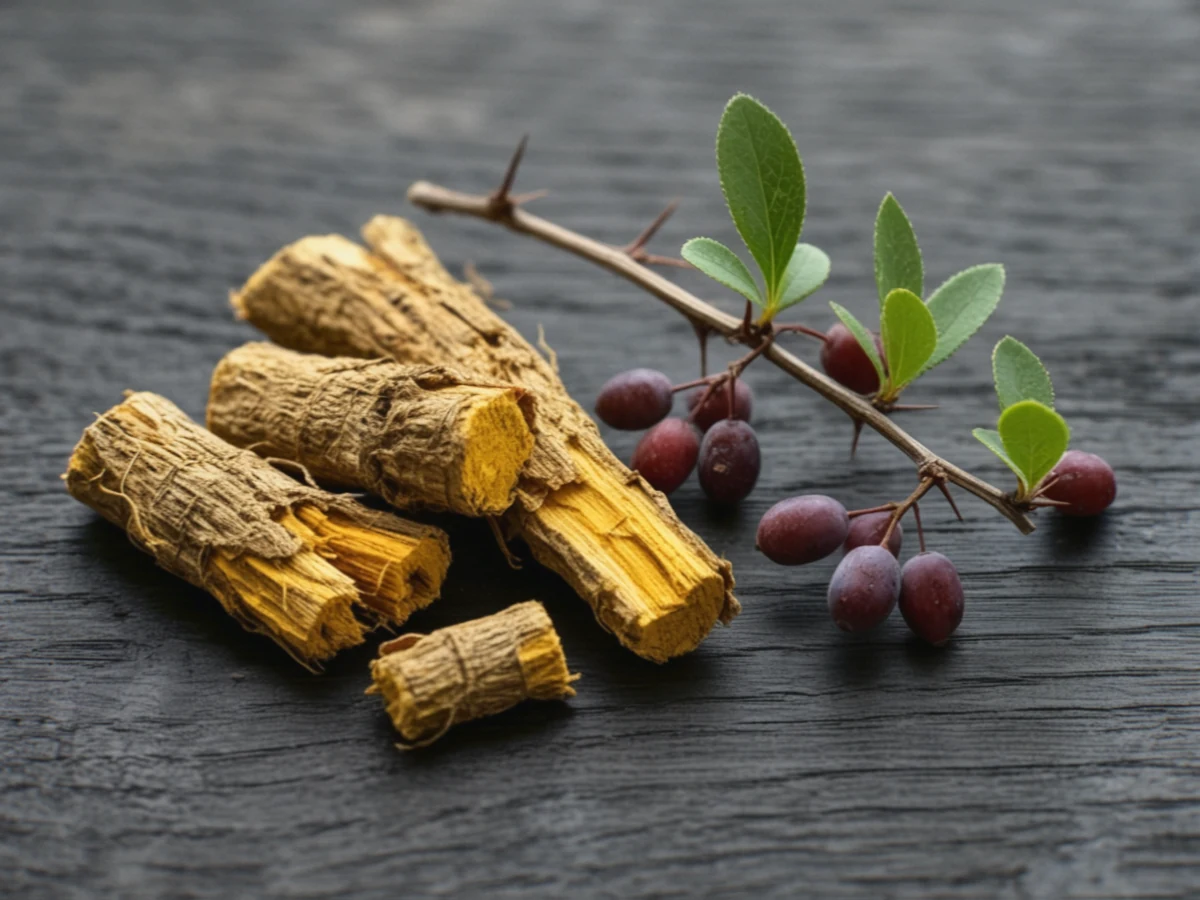
Yellow wood, yellow alkaloid
Berberine HCl from Indian barberry (Berberis aristata DC.), 100 mg per capsule
Indian barberry (Berberis aristata DC., Berberidaceae) grows as a shrub in the Himalayas; its wood and root bark are bright yellow. The colour comes from berberine, an isoquinoline alkaloid that GLP3-B carries as the hydrochloride: a salt form that can be weighed exactly and gives 100 mg per capsule. The powder tastes bitter and turns water yellow.
In 2002 Pan and colleagues isolated three sulphate conjugates of berberine from the urine of five healthy volunteers; the main conjugate was demethyleneberberine-2-sulphate. In pooled human liver microsomes berberine inhibits the enzyme CYP2D6 selectively and quasi-irreversibly (inactivation constant 0.025 min⁻¹, inhibition constant 4.29 µM) and is converted in those microsomes to thalifendine and demethyleneberberine. With recombinant human enzymes CYP2D6 was again the most sensitive (IC₅₀ 7.40 µM); CYP3A4 and CYP1A2 responded far less. CYP2D6 and CYP3A4 also break down many medications. The carton advises anyone taking medication to check with their doctor first.
Literature:
- Pan JF et al.: Identification of three sulfate-conjugated metabolites of berberine chloride in healthy volunteers' urine after oral administration. Acta Pharmacol Sin 2002. PMID 11860742 · https://pubmed.ncbi.nlm.nih.gov/11860742/
- Kim HG et al.: Quasi-Irreversible Inhibition of CYP2D6 by Berberine. Pharmaceutics 2020. PMID 32987920 · https://pubmed.ncbi.nlm.nih.gov/32987920/
- Zhao Y et al.: The in vitro inhibition of human CYP1A2, CYP2D6 and CYP3A4 by tetrahydropalmatine, neferine and berberine. Phytother Res 2012. PMID 21678521 · https://pubmed.ncbi.nlm.nih.gov/21678521/
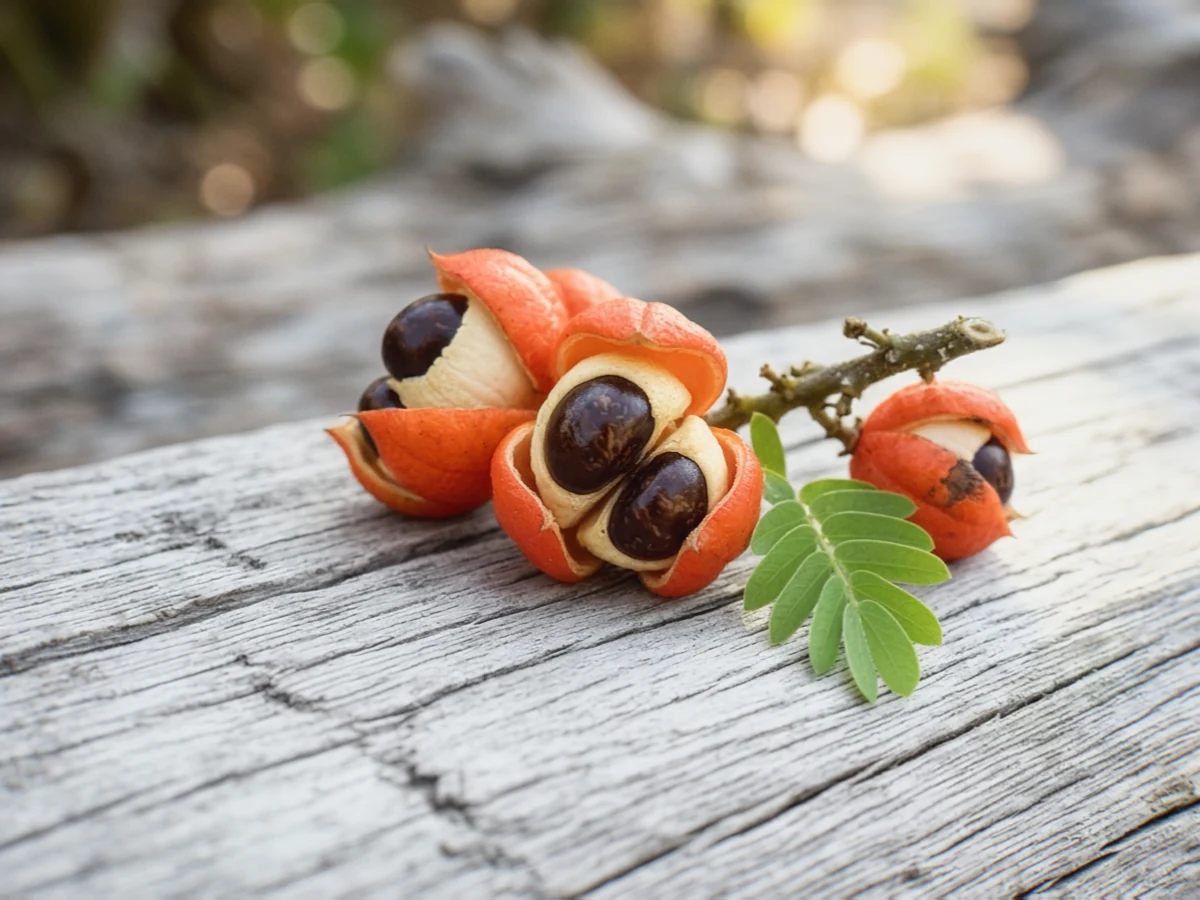
Red capsule, black seed
Guarana extract (Paullinia cupana), 100 mg per capsule
Paullinia cupana Kunth belongs to the soapberry family (Sapindaceae) and climbs as a liana through the Amazon basin; cultivation has traditionally centred on Maués in the state of Amazonas. Ripe fruit capsules are red; they split open to show a black seed in a white aril. The extract is made from the seeds, 100 mg per capsule.
A 2022 UHPLC-MS and chemometrics study separated seed samples from Amazonas, Bahia and Mato Grosso by origin; thirteen procyanidin dimers and trimers marked the origin, while the two main compounds, catechin and epicatechin, bore no relation to it. The plant's caffeine is made by caffeine synthase, which methylates 7-methylxanthine to theobromine and theobromine to caffeine; among more than a hundred caffeine-producing plant species, guarana has the highest caffeine share. EFSA's 2015 opinion sets out caffeine intakes that raise no safety concerns for healthy adults and gives a separate reference value for pregnancy and breastfeeding. The carton carries the caffeine notice for children, pregnant and breastfeeding women.
Literature:
- Cynara de Oliveira Salles R et al.: Geographical origin of guarana seeds from untargeted UHPLC-MS and chemometrics analysis. Food Chem 2022. PMID 34571409 · https://pubmed.ncbi.nlm.nih.gov/34571409/
- Schimpl FC et al.: Production of Recombinant Caffeine Synthase from Guarana (Paullinia cupana var. sorbilis) in Escherichia coli. Methods Mol Biol 2016. PMID 26843165 · https://pubmed.ncbi.nlm.nih.gov/26843165/
- EFSA Panel on Dietetic Products, Nutrition and Allergies: Scientific Opinion on the safety of caffeine. EFSA Journal 2015;13(5):4102 · https://doi.org/10.2903/j.efsa.2015.4102
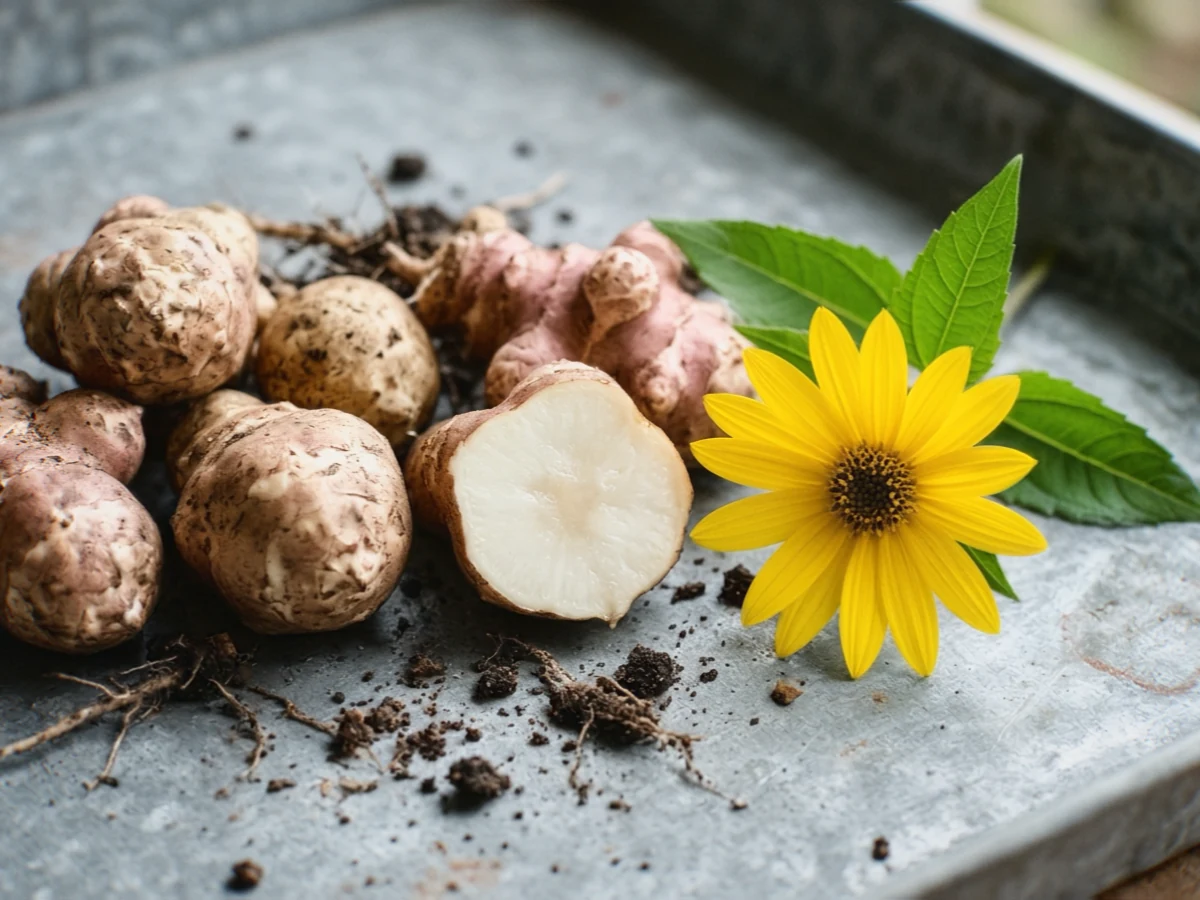
Sunflower with tuber
Inulin from Jerusalem artichoke (Helianthus tuberosus), 100 mg per capsule
Jerusalem artichoke (Helianthus tuberosus L.) is a sunflower relative from North America; the English name is wrong twice over, because the plant is neither from Jerusalem nor an artichoke. Its genome is hexaploid and 21 gigabases in size. It arose about two million years ago from a cross between a tetraploid and a diploid Helianthus species followed by chromosome doubling, and it carries numerous active gene copies for inulin formation.
The tuber stores inulin, a chain of fructose units, rather than starch. Two enzymes purified from the tubers make it: sucrose:sucrose 1-fructosyltransferase (1-SST) first forms 1-kestose from sucrose; together with fructan:fructan 1-fructosyltransferase (1-FFT) it extends the chain up to a degree of polymerisation of 20. GLP3-B contains inulin powder from Jerusalem artichoke at 100 mg per capsule, fixed dose.
Literature:
- Wang S et al.: Haplotype-resolved chromosome-level genome of hexaploid Jerusalem artichoke provides insights into its origin, evolution, and inulin metabolism. Plant Commun 2024. PMID 37974403 · https://pubmed.ncbi.nlm.nih.gov/37974403/
- Lüscher M et al.: Inulin synthesis by a combination of purified fructosyltransferases from tubers of Helianthus tuberosus. FEBS Lett 1996. PMID 8641462 · https://pubmed.ncbi.nlm.nih.gov/8641462/
Two claims, one mineral
Zinc as zinc citrate, 14 mg per capsule (140% NRV)
Zinc in GLP3-B comes as zinc citrate, the zinc salt of citric acid; the compound is listed in Schedule 2 to the Nutrition (Amendment etc.) (EU Exit) Regulations 2019 and in Annex II to Directive 2002/46/EC. At 14 mg per capsule, zinc stands at 140% of the Nutrient Reference Value of 10 mg under Annex XIII of Regulation (EU) No 1169/2011. For zinc, the GB register lists, among others, two claims that appear word for word on the home page:
- Zinc contributes to normal macronutrient metabolism (EFSA Journal 2010;8(10):1819, ID 2890)
- Zinc contributes to normal metabolism of fatty acids (EFSA Journal 2009;7(9):1229, ID 302)
The zinc requirement of higher animals was established in 1934; dietary zinc deficiency in humans was described in 1961, and the requirement has since been estimated factorially and by comparing intake with losses. The body keeps its zinc content steady through two mechanisms: uptake in the intestine and endogenous excretion into the intestine. Excretion responds quickly to small changes in intake, uptake more slowly but across a wide range of intakes, and the two are coordinated.
Literature:
- Sandstead HH: Requirement of zinc in human subjects. J Am Coll Nutr 1985. PMID 3886761 · https://pubmed.ncbi.nlm.nih.gov/3886761/
- King JC et al.: Zinc homeostasis in humans. J Nutr 2000. PMID 10801944 · https://pubmed.ncbi.nlm.nih.gov/10801944/
- EFSA NDA Panel: EFSA Journal 2010;8(10):1819 · https://doi.org/10.2903/j.efsa.2010.1819 · EFSA Journal 2009;7(9):1229 · https://doi.org/10.2903/j.efsa.2009.1229
Trivalent, bound to picolinic acid
Chromium as chromium picolinate, 40 mcg per capsule (100% NRV)
Chromium in GLP3-B comes as chromium picolinate: trivalent chromium complexed with picolinic acid, likewise listed in Schedule 2 to SI 2019/651 and in Annex II to Directive 2002/46/EC. At 40 mcg per capsule it stands at 100% of the Nutrient Reference Value. For chromium, the GB register lists the claim that appears word for word on the home page:
- Chromium contributes to the maintenance of normal blood glucose levels (EFSA Journal 2010;8(10):1732 and 2011;9(6):2203, IDs 262, 4667, 4698)
In the blood, transferrin, the iron transport protein, also carries trivalent chromium. At the bicarbonate concentration of human blood (25 mM) chromium binds to the protein quickly and firmly, whereas in plain buffer binding takes days; the kinetics fit transferrin as the main carrier of chromium(III) into the tissues. A safety assessment from 2004 compared the estimated daily intake of trivalent chromium and picolinic acid from chromium tripicolinate with the acceptable daily intake and found the compound safe for use as a nutrient source in foods.
Literature:
- Deng G et al.: Binding of trivalent chromium to serum transferrin is sufficiently rapid to be physiologically relevant. J Inorg Biochem 2015. PMID 25528477 · https://pubmed.ncbi.nlm.nih.gov/25528477/
- Berner TO et al.: Determining the safety of chromium tripicolinate for addition to foods as a nutrient supplement. Food Chem Toxicol 2004. PMID 15110112 · https://pubmed.ncbi.nlm.nih.gov/15110112/
- EFSA NDA Panel: EFSA Journal 2010;8(10):1732 · https://doi.org/10.2903/j.efsa.2010.1732 · EFSA Journal 2011;9(6):2203 · https://doi.org/10.2903/j.efsa.2011.2203
Branched-chain, one of three
L-leucine, 50 mg per capsule
L-leucine is one of the three branched-chain amino acids (leucine, isoleucine, valine). The body cannot make it; it comes with protein foods. A stable isotope study in humans showed in 1981 that the transamination of leucine proceeds several times faster than the subsequent decarboxylation of the keto acid, in the postabsorptive and in the fed state alike; decarboxylation is the rate-limiting step of the breakdown. A 2023 review brings together the human studies on the tolerable upper intake level: 35 g a day in young adults, 30 g a day in older adults. GLP3-B contains 50 mg per capsule.
Literature:
- Matthews DE et al.: Regulation of leucine metabolism in man: a stable isotope study. Science 1981. PMID 7302583 · https://pubmed.ncbi.nlm.nih.gov/7302583/
- Elango R: Tolerable Upper Intake Level for Individual Amino Acids in Humans: A Narrative Review of Recent Clinical Studies. Adv Nutr 2023. PMID 37062432 · https://pubmed.ncbi.nlm.nih.gov/37062432/
The most abundant free amino acid
L-glutamine, 50 mg per capsule
L-glutamine is the most abundant free amino acid in the human body and part of everyday protein foods. Darmaun and colleagues measured its kinetics in 1986 with ¹⁵N-labelled tracers in healthy young men: the tracer-accessible glutamine pool turned over at 2.8% per minute, the rate of appearance of glutamine amino nitrogen in plasma was 348 micromoles per kilogram per hour, and 5% of the glutamine formed in cells and released into plasma came from intracellular glutamate that had equilibrated with plasma. GLP3-B contains 50 mg per capsule, fixed dose.
Literature:
- Darmaun D et al.: Glutamine and glutamate kinetics in humans. Am J Physiol 1986. PMID 2873746 · https://pubmed.ncbi.nlm.nih.gov/2873746/
Three claims, seven amounts
How the three claims and the full declaration fit together
GLP3-B is a food supplement. The three authorised health claims belong to zinc and chromium and read, in the wording of the GB register and Commission Regulation (EU) No 432/2012:
- Chromium contributes to the maintenance of normal blood glucose levels
- Zinc contributes to normal macronutrient metabolism
- Zinc contributes to normal metabolism of fatty acids
Zinc and chromium carry the authorised claims and form the foundation of the formula. The five companion ingredients complete it as a fixed-dose matrix, each printed on the carton with its exact amount: declaration transparency to the standard of GB and EU food law. Berberine HCl, guarana extract, Jerusalem artichoke inulin, L-glutamine and L-leucine complete origin, galenics and a daily routine built on one capsule. Prices, the current lot and directions are on the home page; the three supply sizes are directly under Prices & packs.
📝 Directions and food supplement information: Food supplement with zinc, chromium, berberine HCl, guarana extract, inulin from Jerusalem artichoke, L-glutamine and L-leucine. Take one capsule a day, whole, with two large glasses of water (about 300–500 ml), 15–30 minutes before or with lunch or dinner. Do not exceed the stated recommended daily dose. Food supplements should not be used as a substitute for a varied and balanced diet and a healthy lifestyle. Contains caffeine (from guarana extract). Not recommended for children, pregnant or breastfeeding women. If you have a pre-existing medical condition, are taking any medication or are under medical supervision, consult your doctor before use. Keep out of the reach of young children.